Abstract
Delivered as a guest address to the Shifa Tameer-e-Millat University & Shifa College of Medicine Students’ Society at their 2026 Annual Event in Islamabad, this talk takes its theme from a single line of Surah Ibrahim: “Its roots are firmly established, and its branches reach into the sky.”
It begins not with the image itself but with the method behind it. The Qur’an makes extensive use of parable, simile and metaphor, and — as the address shows from al-Rum 58, Ibrahim 25 and al-Hashr 21 — it tells us plainly why: so that people may reflect. A parable is not an ornament of language. It takes an abstract truth and brings it before the eye in a form that can be seen and felt. The paper notes that this pattern runs through the Old and New Testaments as well, and may be regarded as a characteristic of the Semitic tradition.
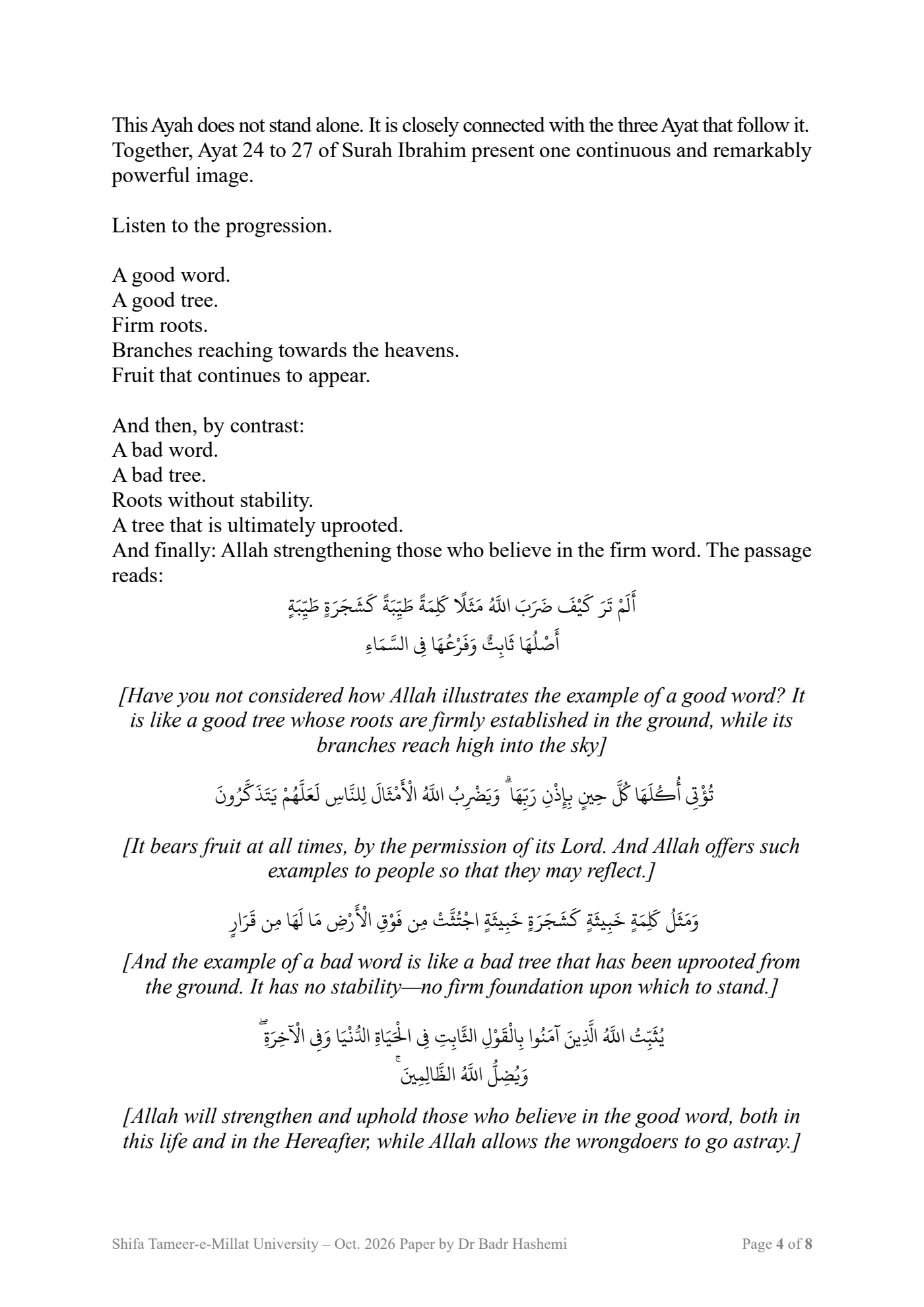
A short section then explains the terms at work — mathal and amthal, the expression dharaba al-amthal, the breadth of khabithah, and the firmness carried by thabit — before turning to the central passage. Read as one continuous progression, Ayat 24 to 27 set a good word beside a good tree: roots firmly established, branches reaching towards the heavens, fruit appearing “at all times, by the permission of its Lord”; and against it a bad word like a tree uprooted from the ground, having no stability to stand on.
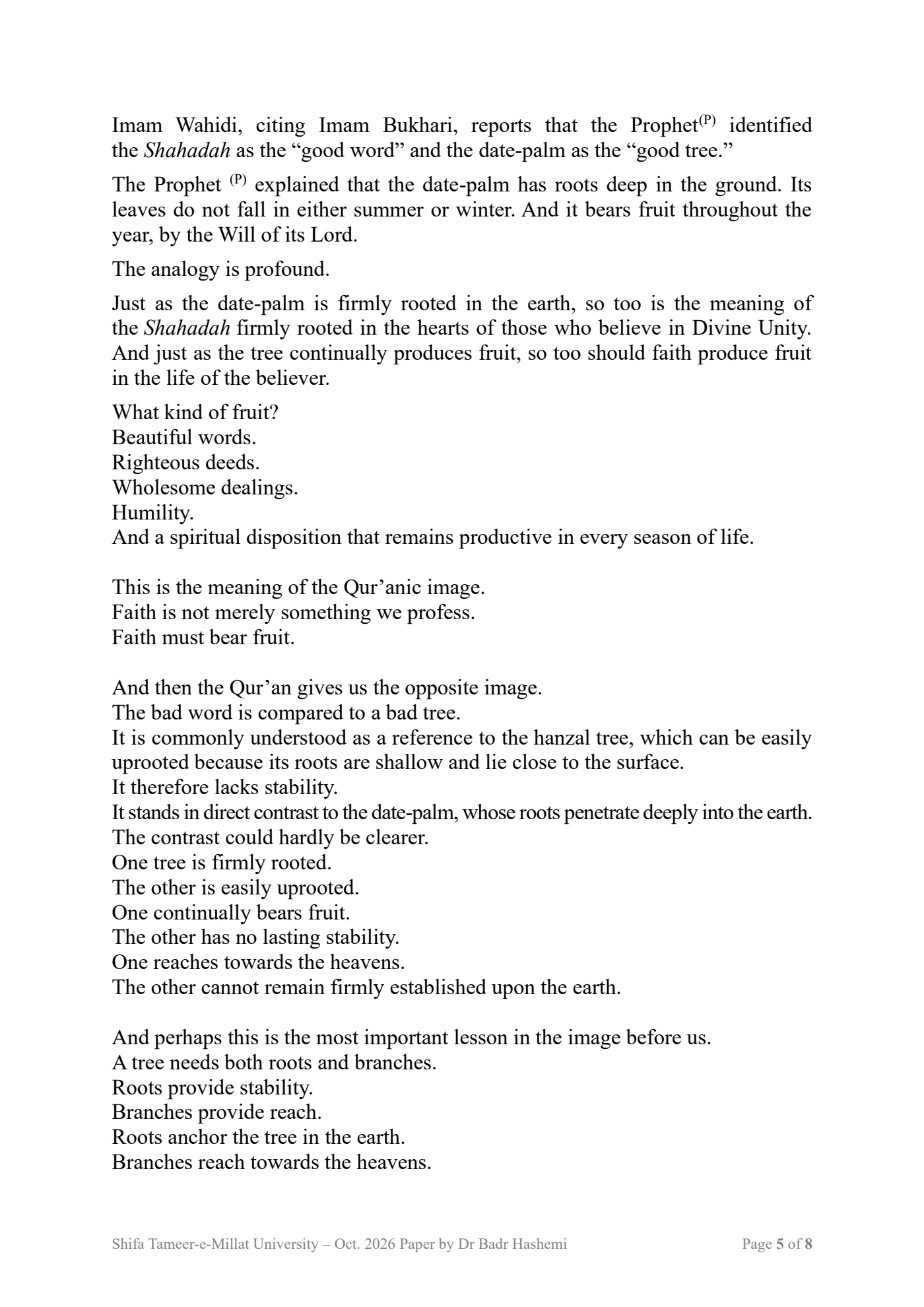
Imam Wahidi, citing Imam Bukhari, reports that the Prophet (peace be upon him) identified the Shahadah as the good word and the date-palm as the good tree — deep-rooted, never bare in summer or winter, fruiting the year round. The address draws the analogy out: faith is not merely something professed, it must bear fruit — beautiful words, righteous deeds, wholesome dealings, humility.
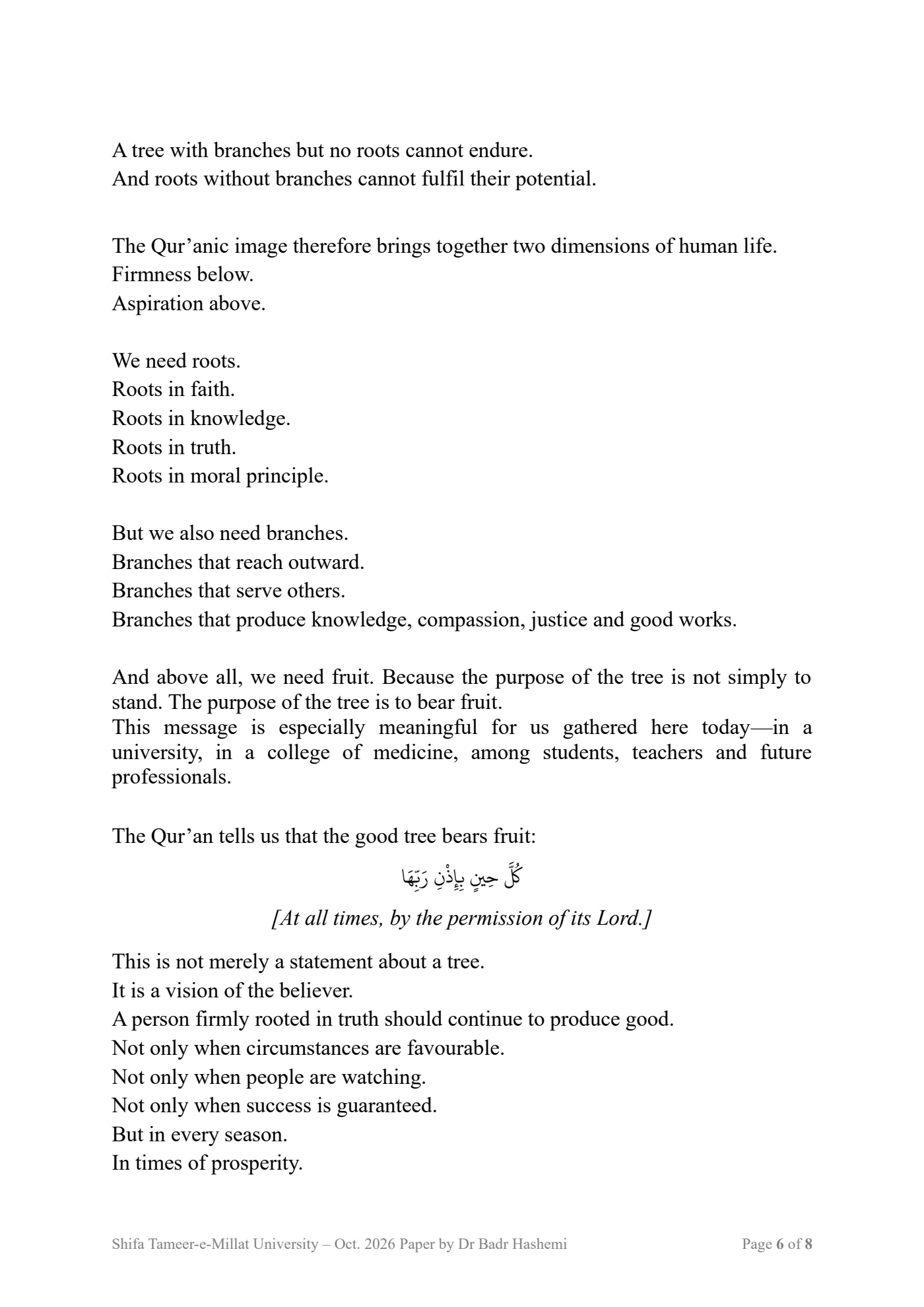
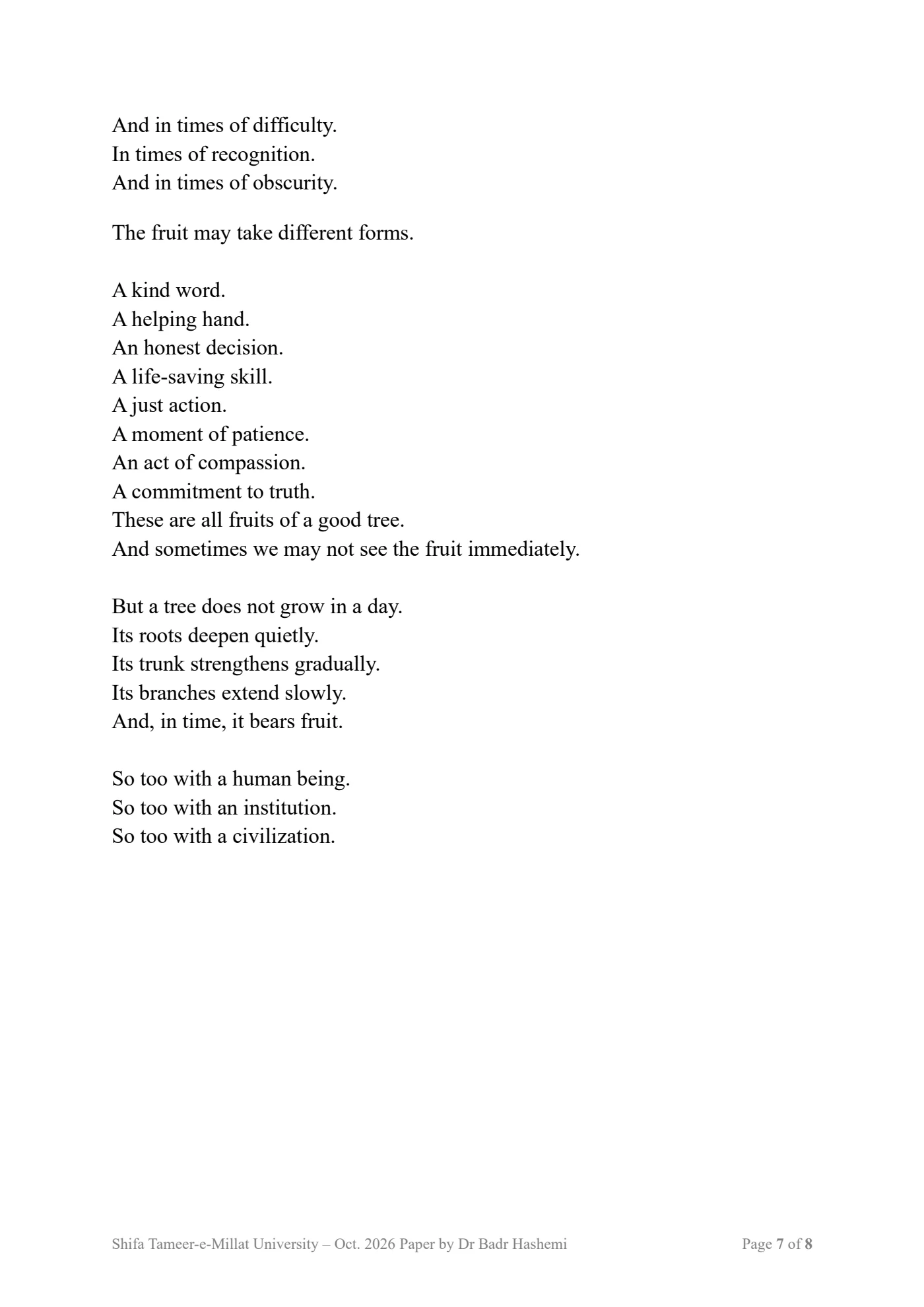
It closes on the lesson it considers most important. A tree needs both roots and branches: roots give stability, branches give reach, and a tree with one and not the other cannot endure or cannot fulfil its potential. Addressed to students, teachers and future physicians, the fruit in question is named plainly — a kind word, a helping hand, an honest decision, a life-saving skill, a just action, a moment of patience — borne not only when circumstances are favourable or people are watching, but in every season. The talk ends with three questions put to the audience: where are our roots, what are our branches reaching towards, and what fruit are we producing?