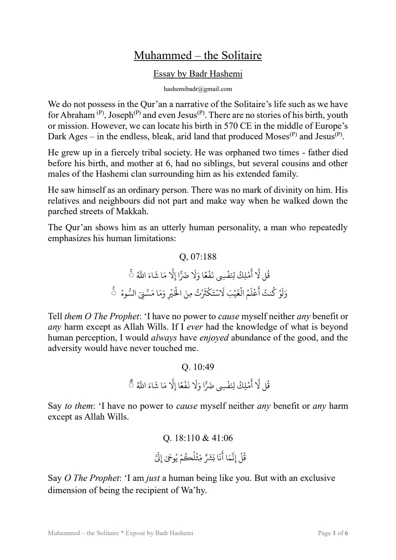
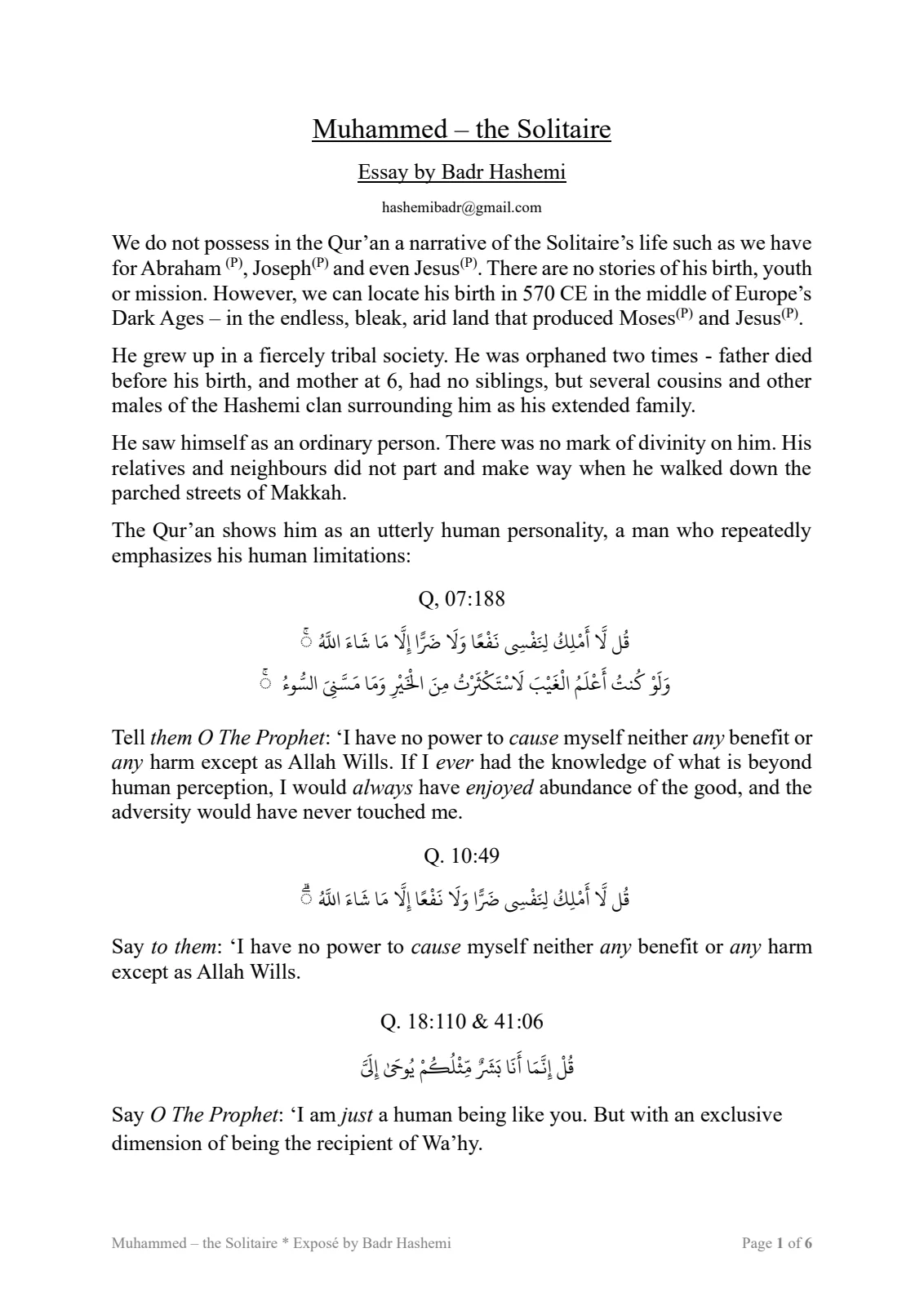
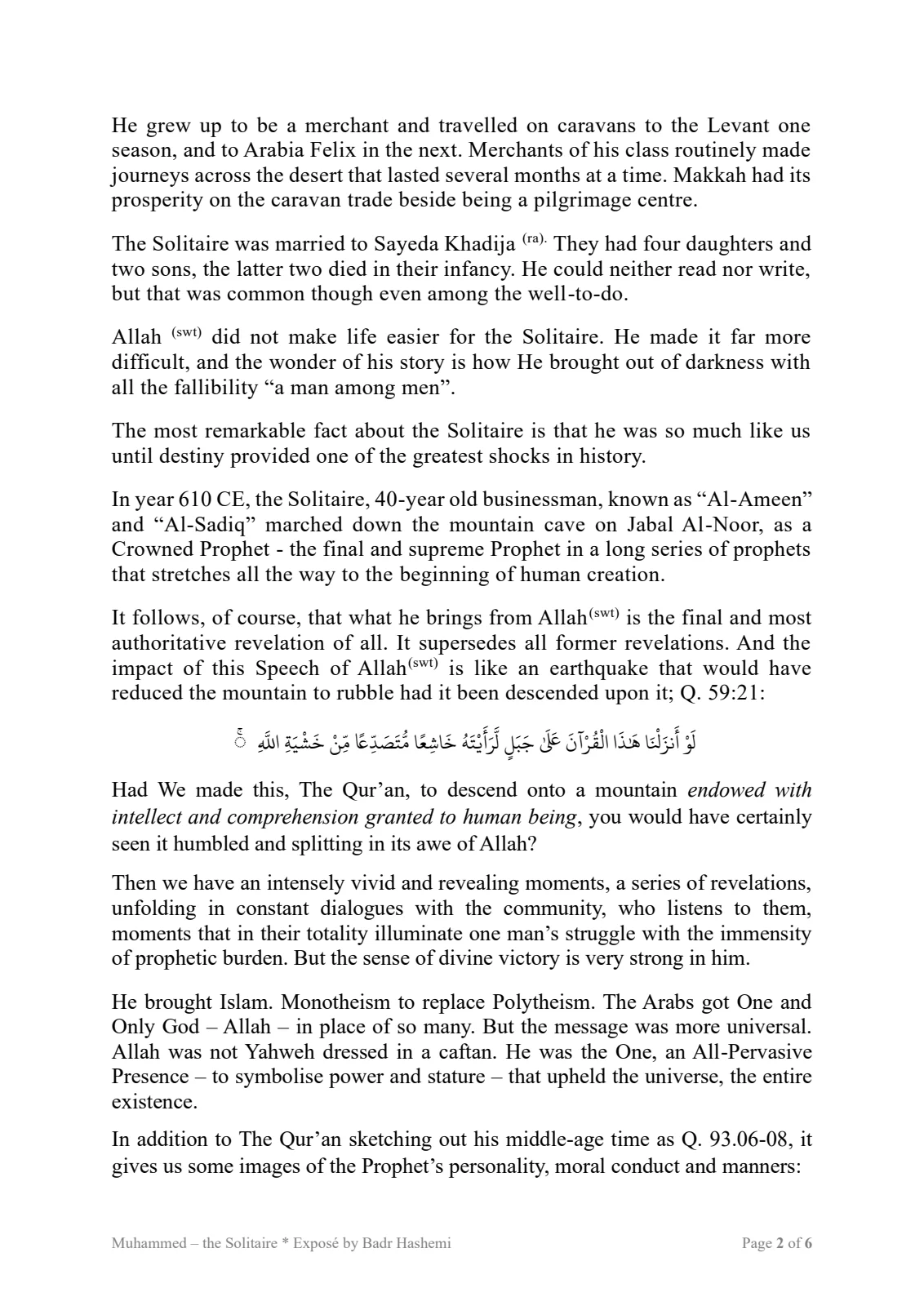
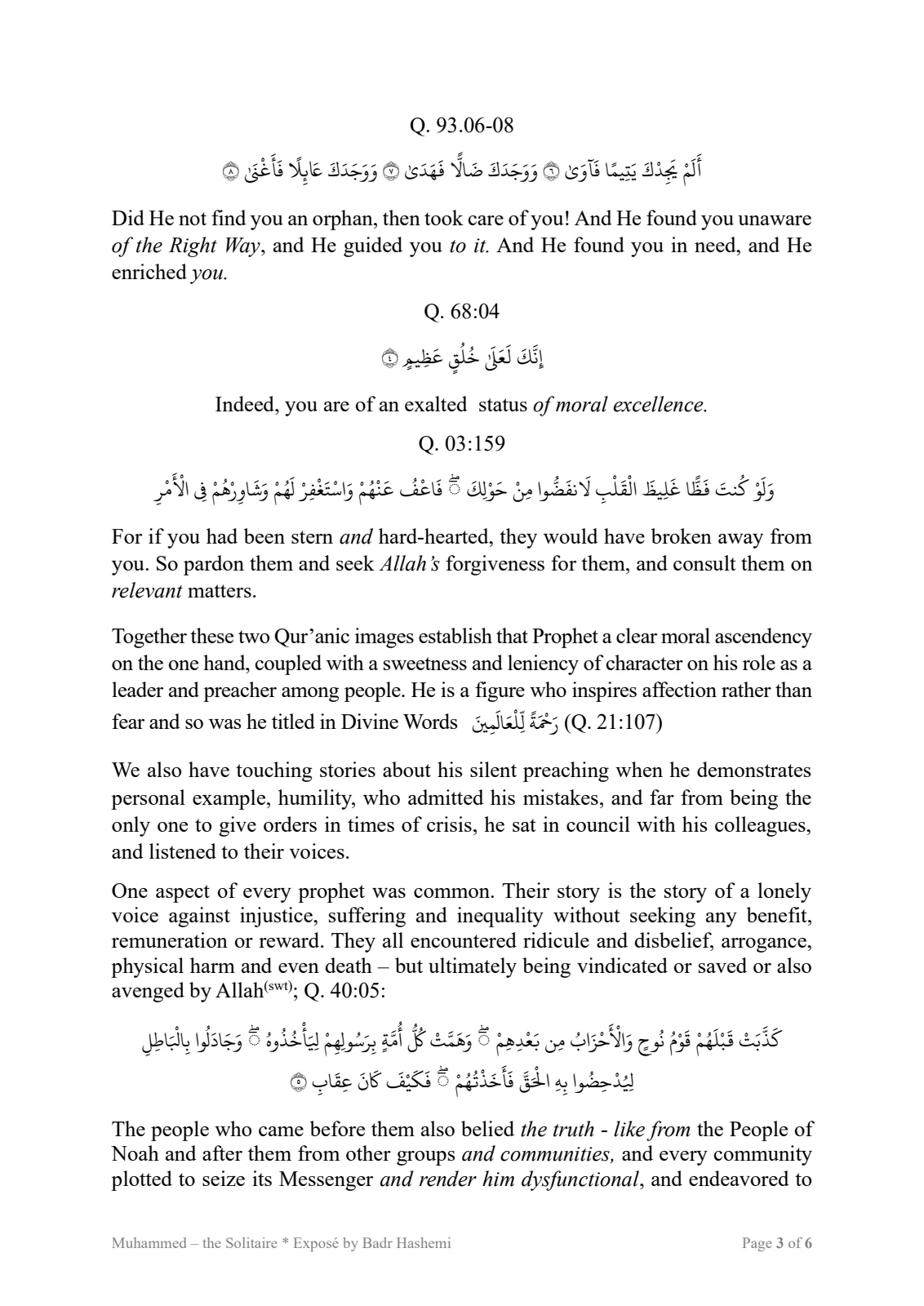
The Qur'an gives us no narrative of the Prophet's birth, youth or mission as it does for Abraham, Joseph and Jesus (peace be upon them). What it gives us instead is something rarer — a portrait of an utterly human personality, a man who repeatedly emphasises his own limitations, and who is nonetheless set apart by title, by character, and by the Book entrusted to him.
Free to read and free to download — no account needed.
Muhammed — the Solitaire · 6 pages
Abstract
This essay approaches the Prophet Muhammad (peace be upon him) through a single, deliberately narrow lens: how the Qur'an itself speaks of him. Rather than retelling the Seerah, it gathers the Book's own testimony — and finds a figure whose humanity is insisted upon rather than softened.
Born in 570 CE into a fiercely tribal society and orphaned twice over, he grew into a merchant of the caravan routes to the Levant and Arabia Felix — unlettered, unremarkable to his neighbours, bearing no visible mark of divinity. The Qur'an has him say plainly: "I have no power to cause myself neither any benefit or any harm except as Allah Wills."
Against that insistent ordinariness the essay sets what the Qur'an does single out: an exalted moral station, a leniency of character that draws people rather than drives them away, a title in place of a name where earlier prophets were addressed as Ya Ibrahim, Ya Musa, Ya Isa — and the remarkable pattern by which Allah ties Himself to him some twenty-nine times. It closes on what he left behind: the Qur'an itself, and a model of conduct the community was directed to follow.
What the essay covers
Why the Qur'an gives no birth or childhood narrative — and what it offers instead
The verses in which the Prophet states his own human limitations
The orphan, the merchant, the unlettered man known as Al-Ameen and Al-Sadiq
Moral ascendency paired with leniency — the two Qur'anic images of his character
The charges of his adversaries — sorcerer, poet, soothsayer — and the Qur'an's answer
Title in place of name, and the twenty-nine ties between Allah and His Messenger